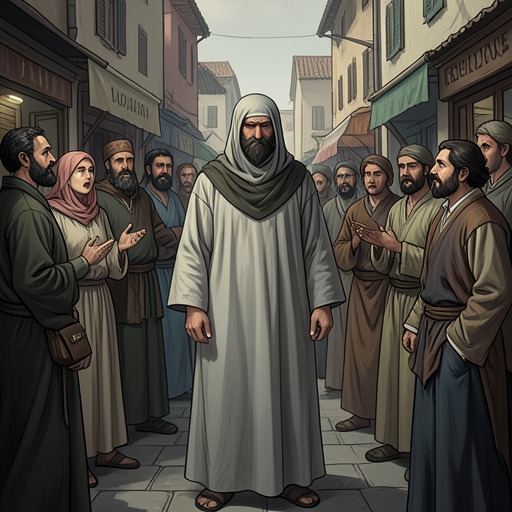
The Satanic Verses
The Satanic VersesThe Satanic Verses are a recitation that Mahound first presents publicly as revelation and later repudiates as the work of Shaitan. Their importance lies not only in the reversal itself but in the novel’s refusal to settle who speaks through the Prophet: Gibreel, Mahound, or an agency neither can reliably distinguish. The disputed words alter the political and religious fortunes of Jahilia, while later episodes echo the same uncertainty through a scribe who secretly changes what he records.
The first recitation and its political stakes
Before the public recitation, Mahound faces a proposal from Abu Simbel: recognition for the new faith in return for approval of Lat, Uzza, and Manat, with Mahound offered a place on Jahilia’s council. Salman the Persian warns that accepting could make Mahound appear to have arranged a convenient revelation and expose him as a fraud. He also argues that abandoning the creed the faithful have been reciting would make them seem weak and unserious. Mahound replies that the new faith already attracts little attention, with small audiences and public lampoons. The dispute places spiritual authority in the same scene as compromise, political recognition, and the survival of a vulnerable community.
When Mahound speaks in the great tent, the audience initially expects entertainment rather than religious instruction. Abu Simbel insists that if Mahound’s God has spoken, the whole world must hear. Mahound announces “The Star,” and scribes begin to write. After verses concerning his vision and the signs of the Lord, he recites lines naming Lat, Uzza, and Manat, followed by: “They are the exalted birds, and their intercession is desired indeed.” The response is immediate and public. Hind rises; Abu Simbel stands, then performs the gestures and words of Muslim prayer, and Hind follows his lead. The congregation kneels in a movement that spreads from them through the tent and the crowd outside. Khalid, the water-carrier, watches in horror and runs away, while Mahound remains standing. The recitation thus works as an utterance with visible political effects: Abu Simbel’s apparent acceptance helps bring the assembled community into worship, even as Mahound’s own posture remains apart from it.
Listening, doubt, and repudiation
The novel frames the origin of the verses through Mahound’s “listening,” a state that blurs ordinary sleep and waking. Gibreel experiences a strange intimacy with the Prophet: he feels himself bound to Mahound, uncertain whether the angel is inside the Prophet or whether one dreams the other. In another such episode, Mahound asks why people who have witnessed apparent miracles still worship the town’s deities. He remembers the Night Journey and his ascent, including the reduction of a burden of forty daily prayers to five after Moses urges him to plead for fewer. Yet he remains uncertain what to recite and wonders whether Lat, Manat, and Uzza might be angels or daughters of God. His doubts include spiritual questions and worldly self-scrutiny: he considers the council seat, the possible sincerity of Abu Simbel, and whether accepting the offer would be wise or self-serving. Gibreel, for his part, is unable to supply an answer.
After a prolonged struggle with Gibreel, Mahound wakes in the wilderness and concludes that the speaker in the earlier encounter was the Devil disguised as the archangel. He hurries back to Jahilia to remove the verses from the record. The narration makes that explanation unstable, however: Gibreel knows that he was present both when the verses were delivered and when they were withdrawn, and says that both the statement and its repudiation came through his mouth. Mahound returns to the House of the Black Stone and publicly abrogates the disputed passage. In its place he recites: “Shall He have daughters and you sons?” and “These are but names you have dreamed of, you and your fathers. Allah vests no authority in them.” The reversal is decisive as an action in the story, but it does not resolve the deeper question of how revelation is heard, transmitted, or distinguished from deception.
Consequences for the faithful
After the repudiation, Mahound returns home and finds his seventy-year-old wife dead. The account presents her death as punishment or vengeance without identifying its source or establishing a direct cause. Mahound withdraws into grief and says little for weeks. Meanwhile, Abu Simbel institutes persecution of the adherents of Submission: they are confined to a poor quarter, placed under curfew, and barred from employment. The faithful also face assaults, harassment, and attacks on their homes. Despite these pressures, their numbers grow. The episode therefore links the recitation’s reversal to both a political crackdown and the community’s persistence, without making the expansion of persecution a simple end to its influence.
An offer of shelter arrives from Yathrib, and Hamza urges Mahound to leave Jahilia because the message cannot be completed there. Mahound consents while grieving, and the faithful prepare to depart. Khalid, who had fled the tent in horror, stays behind to apologize. He now interprets the episode as a trial that let the faithful witness evil and its overthrow. Mahound answers with bitterness rather than endorsing this consoling account. The gap between Khalid’s retrospective explanation and Mahound’s response keeps the episode from becoming a settled lesson: even its participants disagree about what the event meant.
Repetition, textual authority, and framing
The problem of who controls sacred language recurs in Salman the Persian’s later account. After a dream in which he hovers above Mahound at the cave on Mount Cone, Salman recalls the Satanic Verses episode and wonders whether he had been Shaitan. He then describes secretly altering the rules he writes down. He first substitutes “all-wise” for “all-hearing, all-knowing”; later, he writes “Jew” where Mahound said “Christian.” Mahound accepts the changes, and Salman becomes distressed by the possibility that his writing cannot be distinguished from revelation. When he sees Mahound hesitate over a later alteration, Salman fears the next attempt will expose him. He chooses flight over risking destruction alongside the Prophet and leaves Yathrib for Jahilia. His story does not establish that the earlier verses and his later edits are identical events; rather, the parallel renews the question of how divine speech becomes a written text and who can recognize a change.
The novel’s ending matter-of-factly identifies its Qur’an quotations as composites drawn from English versions by N. J. Dawood and Maulana Muhammad Ali, with some additions by the author. That disclosure locates the book’s scriptural language within an acknowledged act of literary composition. Read alongside Mahound’s uncertain listening, Gibreel’s divided role, Salman’s unnoticed substitutions, and the later dispute over whether a visionary should quote an angel precisely, the episode becomes a sustained inquiry into the authority of words: who hears them, who records them, who interprets them, and what follows when their source cannot be securely known.